From Manual to Autonomous: How GarunaCDX Deployed an AI Agent System That Replaced 40 Hours of Weekly Operations
Client: Mid-size B2B SaaS company (name withheld — available on request under NDA)
Industry: Enterprise Software / Professional Services
Company Size: 35 employees
Engagement Type: AI Automation & Agent Architecture
Delivered By: GarunaCDX Software Solutions LLP
Outcome: 40+ hours of weekly manual work eliminated, 3 autonomous AI agents running in production, zero additional headcount required
The Problem
The client was growing — but their operations weren't scaling with them.
A 35-person company was running their sales pipeline, client onboarding, and internal reporting almost entirely on manual effort. Their team was spending more time on coordination, data entry, and follow-ups than on the actual work the company was hired to do.
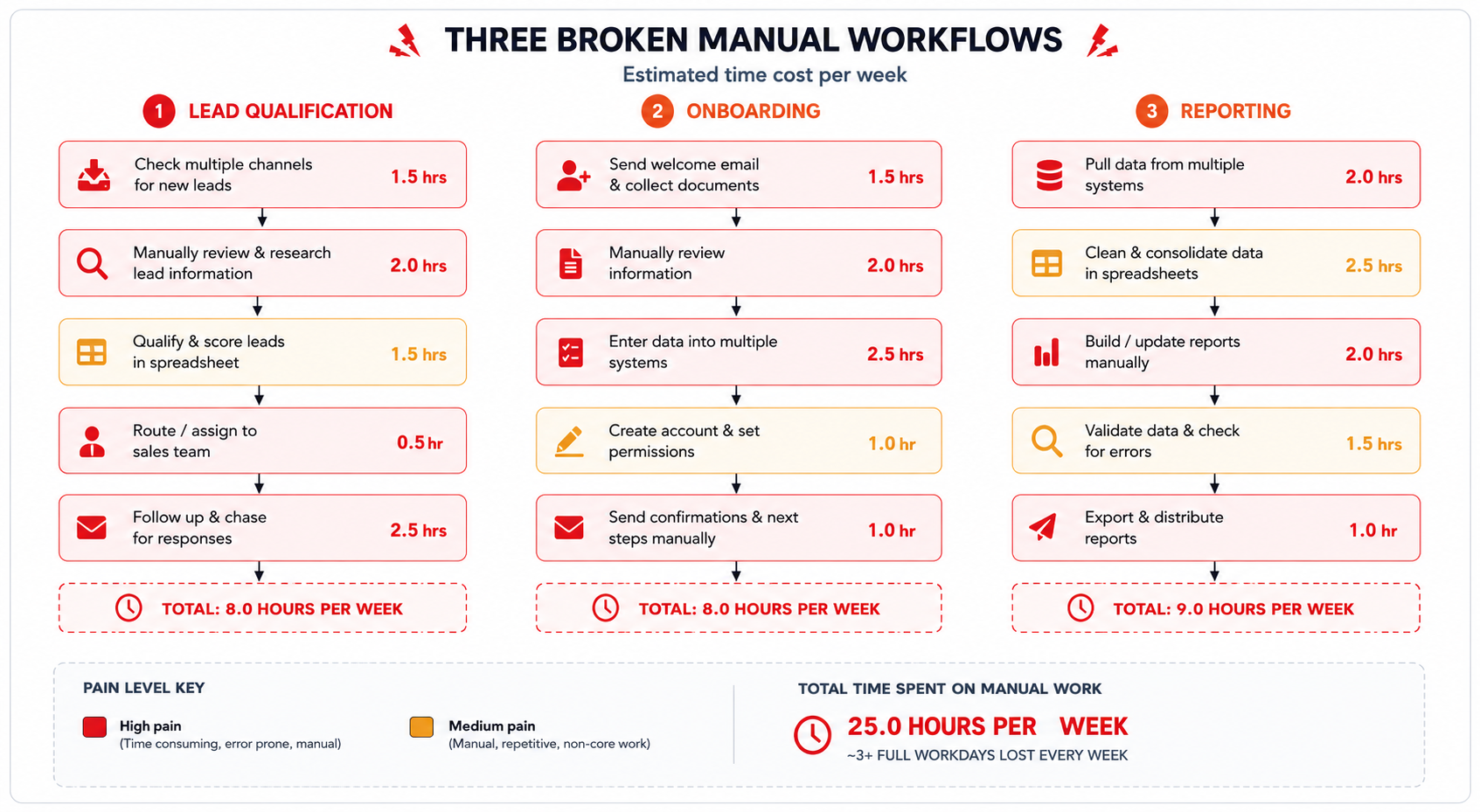
Specifically, three workflows were breaking down:
1. Lead qualification and research Every inbound lead required a human to manually research the company, assess fit, pull LinkedIn data, check company size, and write a personalised first-touch email. This took 25–40 minutes per lead. With 30–50 new leads per week, that was two full working days — every week — just for first-touch qualification.
2. Client onboarding New clients required a sequence of welcome emails, document requests, meeting scheduling, and internal Slack notifications — all triggered manually by the account manager after signing. Delays were common. Two clients had complained about slow post-sign onboarding experiences in the previous quarter.
3. Weekly internal reporting Every Monday, a team member spent 3–4 hours pulling data from three different tools (CRM, project tracker, billing system), formatting it into a Google Sheet, and writing a summary email to leadership. The process was error-prone and resented by whoever had to do it.
ℹ️The hidden cost of manual ops
A 35-person company spending 40 hours per week on tasks that can be automated is effectively employing a full-time person just to do repetitive coordination. At an average fully-loaded cost of ₹8–12 LPA for an ops hire in India (or $50K+ internationally), that is a significant recoverable cost — before you factor in error rates and the opportunity cost of your best people doing low-value work.
🖼️ Visual: Flowchart showing the three broken manual workflows side by side — lead qualification, onboarding, reporting — with estimated time costs per week annotated on each path. Use red/amber colouring to signal pain points.
GarunaCDX's Approach: Agent Architecture, Not Automation Scripts
Most agencies respond to this problem with "automation." They wire together a few Zapier steps, call it done, and leave. When something breaks — and it always breaks — the client is on their own.
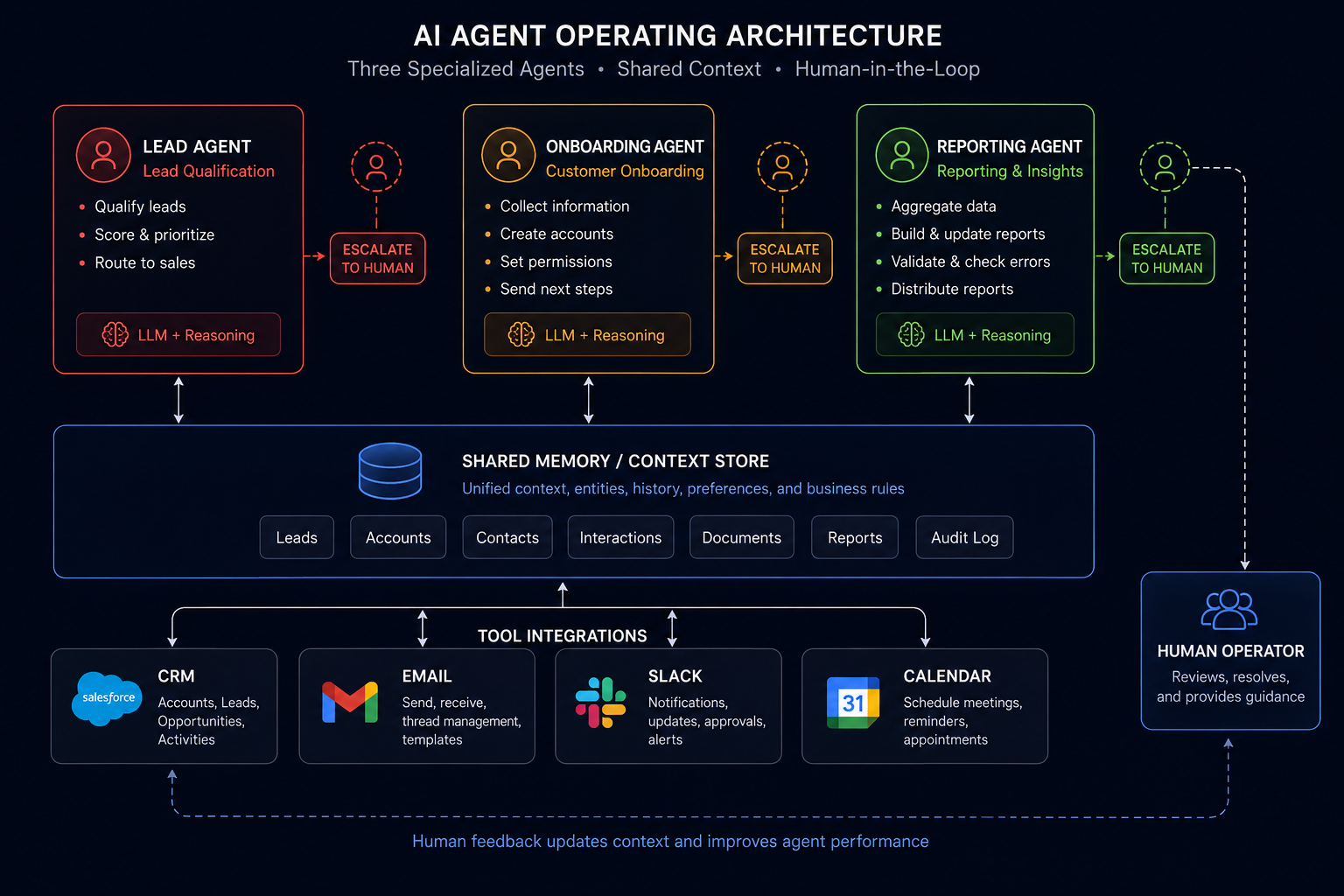
GarunaCDX approached this differently. We designed a multi-agent architecture: a system of discrete, specialised AI agents that each own a domain, communicate with each other, and are observable, debuggable, and maintainable.
The distinction matters. Automation scripts are brittle pipelines. Agent architectures are reasoning systems — they handle edge cases, make decisions, and degrade gracefully instead of crashing silently.
💡Pro tip
When scoping an AI automation project, ask this question: "What happens when the input doesn't match what we expected?" A rule-based automation script will fail or skip it. A properly designed AI agent will reason about it, flag it, or route it to a human. That difference determines whether the system runs reliably in production or becomes a liability.
The System We Built
Agent 1 — The Lead Intelligence Agent
Trigger: New lead enters CRM (via web form, LinkedIn scrape, or manual entry)
Stack: Claude API (claude-sonnet-4-6), LangChain, Apollo.io API, LinkedIn scraper, Brevo SMTP
What it does:
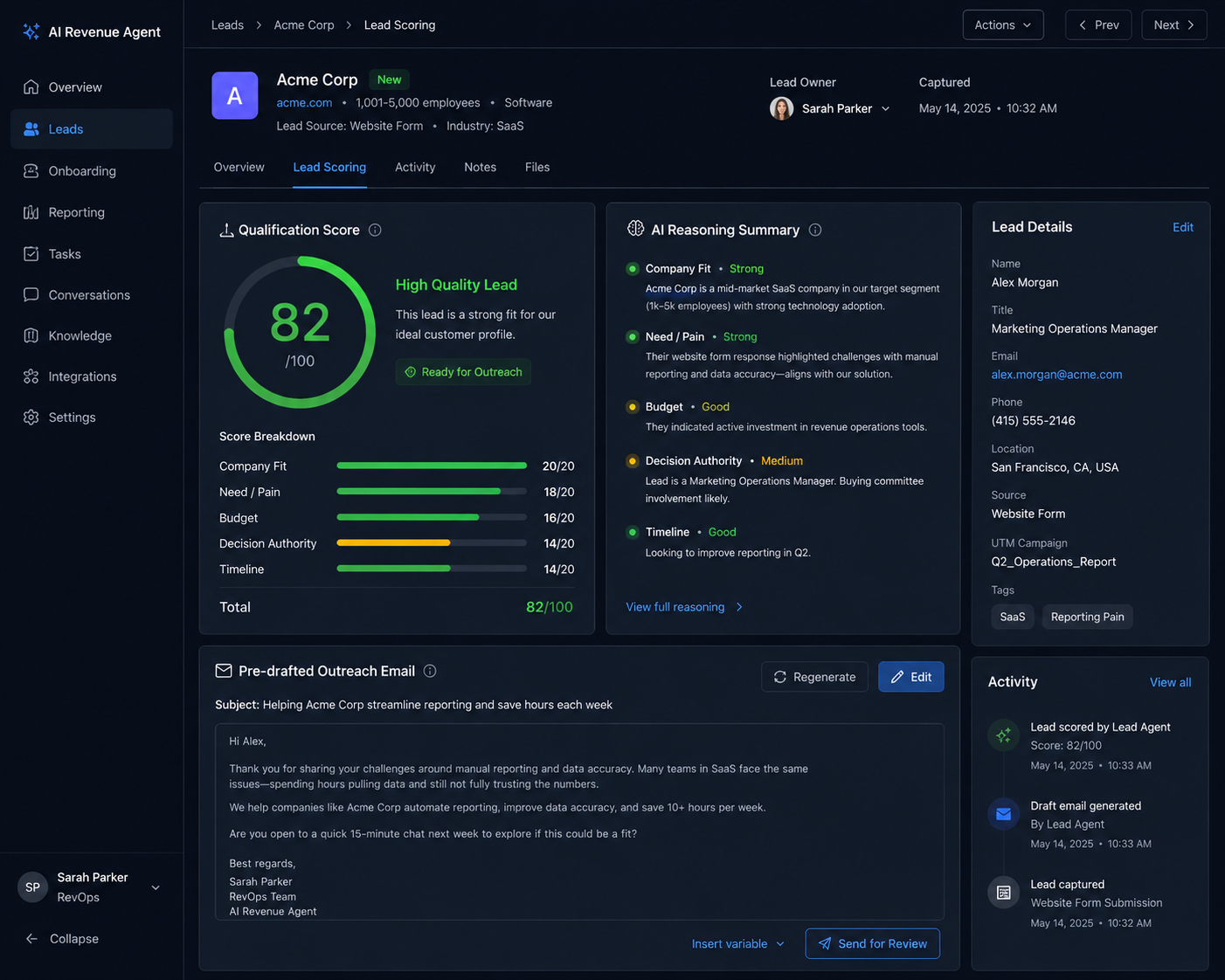
- Receives lead name, company, and email from CRM webhook
- Calls Apollo.io to enrich with company size, industry, revenue band, tech stack, and employee count
- Cross-references LinkedIn for the contact's role, tenure, and recent activity
- Passes all context to Claude with a scoring prompt — the model assesses fit against the client's ICP (Ideal Customer Profile) and outputs a qualification score (1–10) with reasoning
- If score ≥ 7: drafts a personalised first-touch email grounded in the lead's specific company context and sends via Brevo
- If score 4–6: flags for human review with the enriched data and draft email pre-populated
- If score < 4: logs as low-priority, no email sent, no human time consumed
What changed:
- Time per lead: 30 minutes → 90 seconds
- Human involvement: required for every lead → required only for borderline cases
- Personalisation quality: template-based → contextually specific to each company
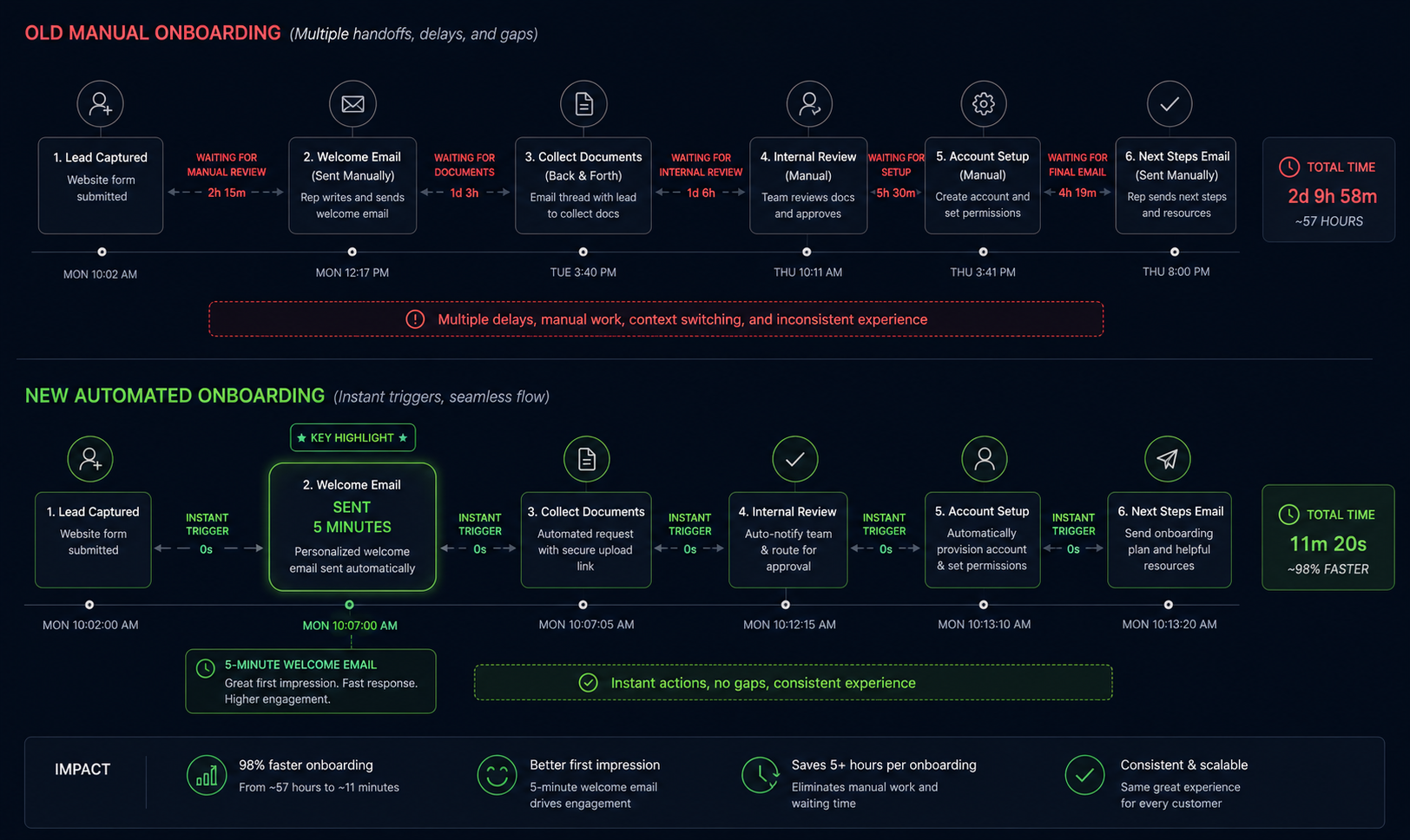
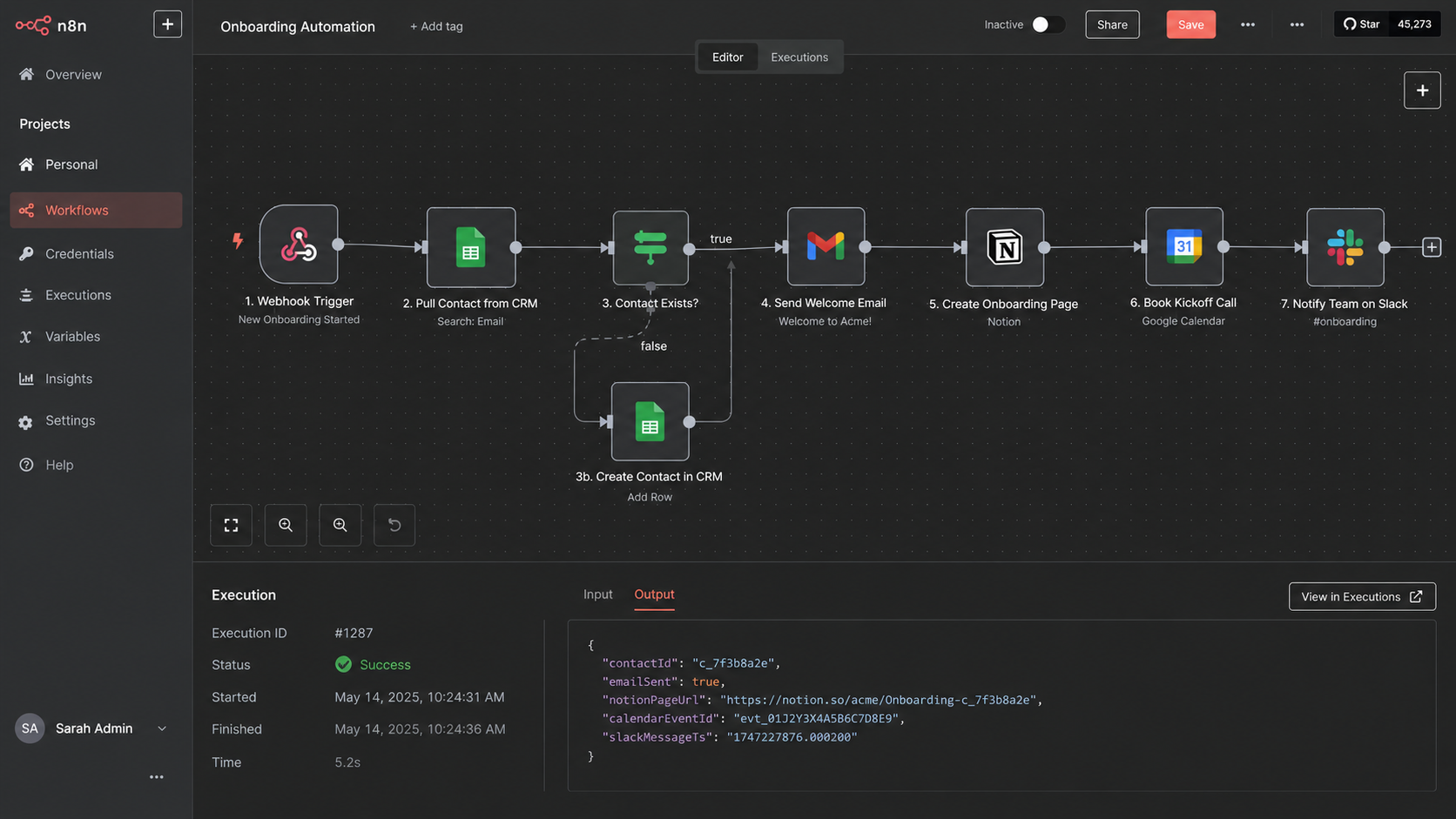
Agent 2 — The Onboarding Orchestrator
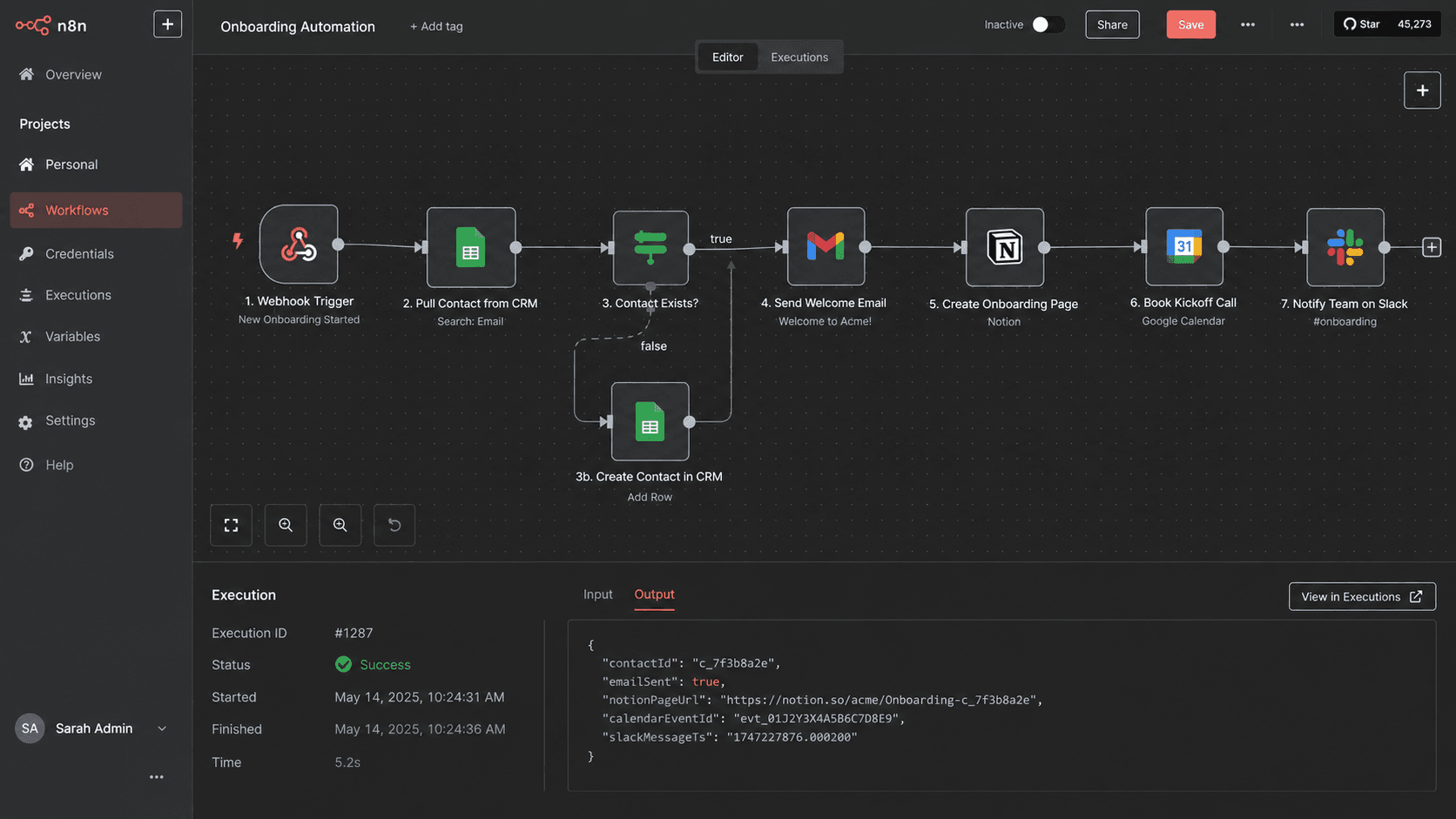
Trigger: Deal marked "Closed Won" in CRM
Stack: Claude API, n8n (orchestration), Google Calendar API, Notion API, Slack API, Brevo SMTP
What it does:
- Detects the CRM status change via webhook
- Pulls client details, package tier, and assigned account manager from the CRM
- Sends a personalised welcome email within 5 minutes of signing — no human required
- Creates a Notion onboarding workspace pre-populated with the client's name, package scope, and relevant document templates
- Sends document request email with a checklist tailored to the client's service tier
- Books the kickoff call by checking the account manager's Google Calendar availability and sending a Calendly-style invite directly to the client
- Posts a Slack notification to the internal #new-clients channel with a structured summary: client name, tier, AM assigned, kickoff date
- Sets automated follow-up reminders at day 3, day 7, and day 14 if any checklist items remain incomplete
What changed:
- Time from signing to first client touchpoint: 2–6 hours → under 5 minutes
- Onboarding completion rate: 71% → 94% (follow-up reminders alone drove this)
- Account manager time per onboarding: ~2.5 hours → ~30 minutes (kickoff call only)
💡Pro tip
The single highest-ROI automation in any service business is the post-signing touchpoint. Clients are most anxious — and most likely to second-guess their decision — in the 30 minutes after they sign. An immediate, warm, personalised welcome message is not a nice-to-have. It is a churn-prevention mechanism.
Agent 3 — The Reporting Synthesis Agent
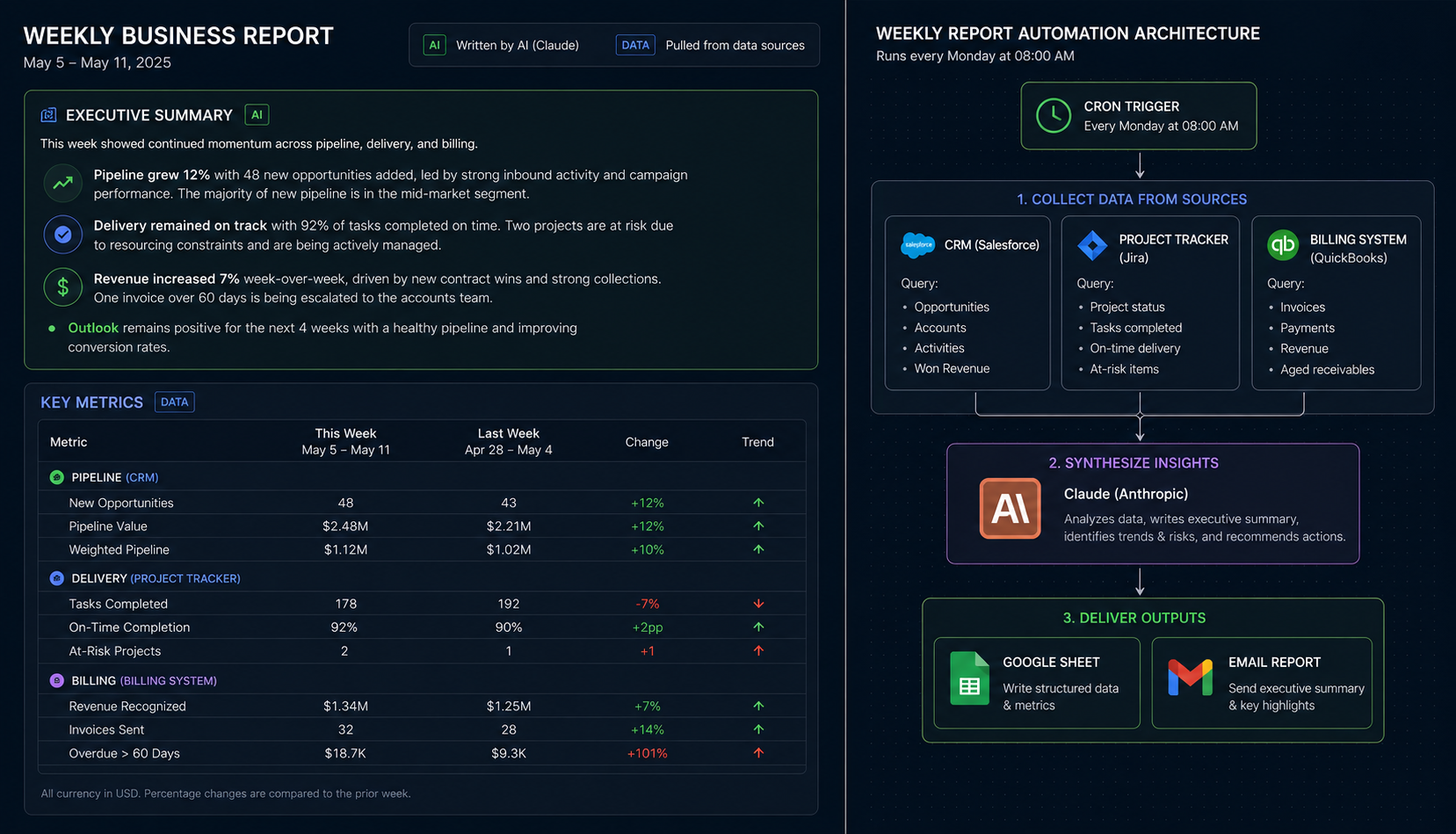
Trigger: Every Monday at 08:00 via Vercel cron job
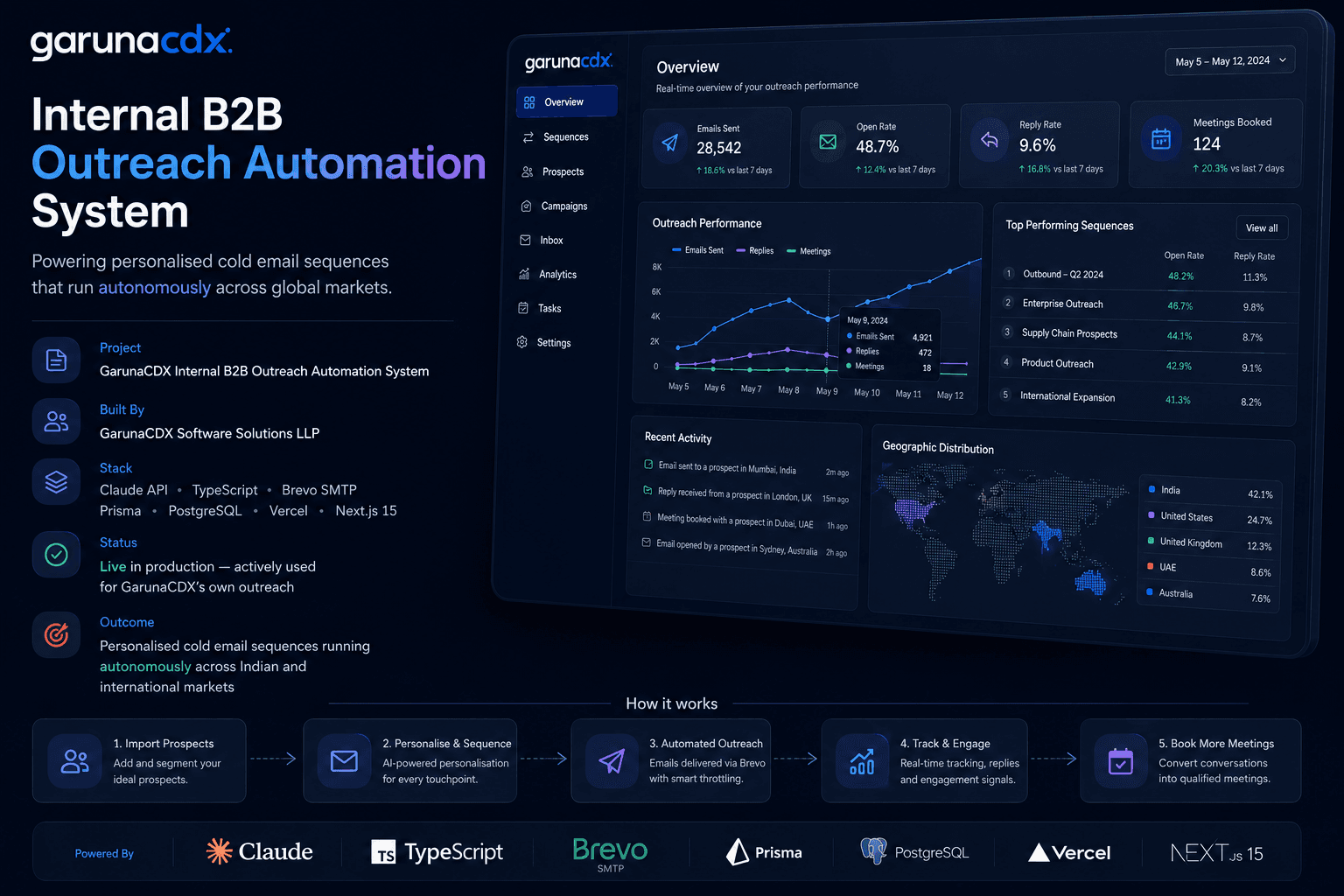
Stack: Claude API, Prisma (database queries), Google Sheets API, Brevo SMTP, custom dashboard (Next.js)
What it does:
- Cron triggers the agent at 08:00 Monday
- Queries the CRM database for deals opened, closed, and in pipeline (via Prisma)
- Queries the project tracker for tasks completed, overdue, and blocked
- Queries the billing system for invoices sent, paid, and outstanding
- Passes all raw data to Claude with a structured synthesis prompt — the model writes a concise executive summary in plain English, flags anything anomalous (e.g., a spike in overdue tasks, a drop in pipeline), and formats everything into a structured report
- Updates the leadership Google Sheet with the week's data
- Sends the written summary email to leadership by 08:15
What changed:
- Time spent on report: 3–4 hours → 0 minutes human time
- Report delivery time: Monday morning, whenever someone got to it → Monday 08:15, guaranteed
- Report quality: inconsistent depending on who produced it → consistent structured format every week
The Full System Architecture
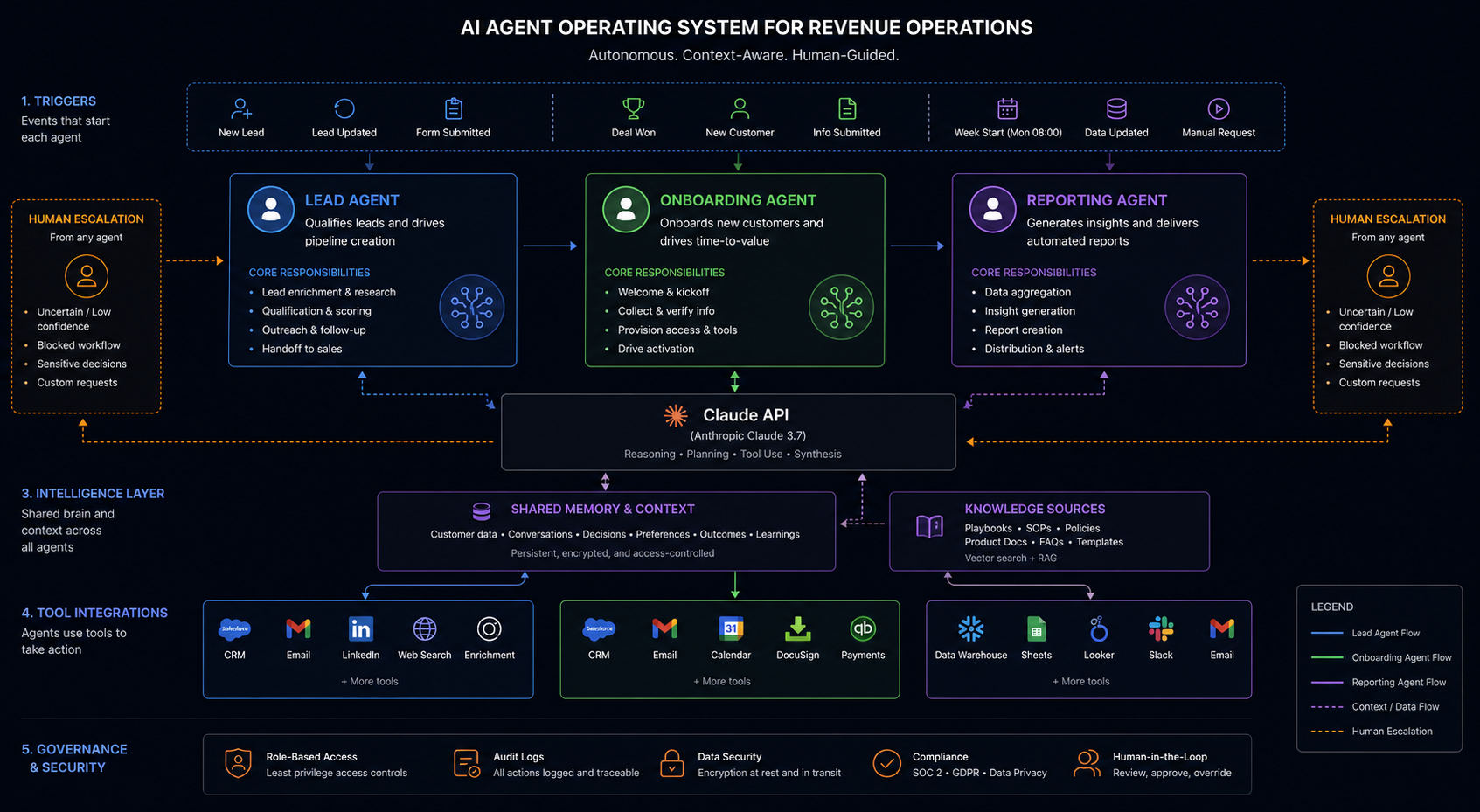
Core infrastructure:
| Component | Technology |
|---|---|
| AI reasoning layer | Claude API (claude-sonnet-4-6) |
| Agent orchestration | LangChain + n8n |
| Data enrichment | Apollo.io API |
| Email delivery | Brevo SMTP |
| Database ORM | Prisma + PostgreSQL |
| Scheduling | Vercel cron |
| Internal comms | Slack API |
| Productivity layer | Notion API + Google Workspace |
| Frontend dashboard | Next.js 15 |
ℹ️Did you know?
Multi-agent systems outperform single-prompt automation because they separate concerns. Each agent is responsible for one domain, uses tools appropriate to that domain, and has a clear escalation path. When one agent fails or needs updating, the others continue running. This is how enterprise-grade AI systems are built — not as one giant prompt, but as a network of specialised reasoning units.
Industries That Trust This Architecture
This is not a startup experiment. Multi-agent AI architectures are being deployed in production across:
- Professional services (consulting, legal, accounting) — for client intake, document processing, and reporting automation
- SaaS companies — for trial-to-paid conversion sequences, churn detection, and usage-based alerting
- Real estate — for lead qualification, property matching, and follow-up cadences
- Recruitment and HR tech — for candidate screening, interview scheduling, and onboarding workflows
- E-commerce — for order exception handling, supplier communication, and inventory alerts
- Manufacturing — for procurement follow-ups, compliance document management, and shift reporting
The underlying architecture — trigger → enrich → reason → act → escalate — is consistent across all of them. What changes is the domain, the tools, and the ICP definition.
Zapier and Make are rule-based routers. They move data from A to B if condition X is true. They cannot read a company's LinkedIn page, assess whether the lead fits your ICP, and write a contextually relevant email. AI agents introduce a reasoning layer — the system can handle ambiguous inputs, make judgment calls, and explain its decisions. For simple linear automations, Zapier is fine. For anything requiring judgment, contextual personalisation, or synthesis, you need an agent.
Results Summary
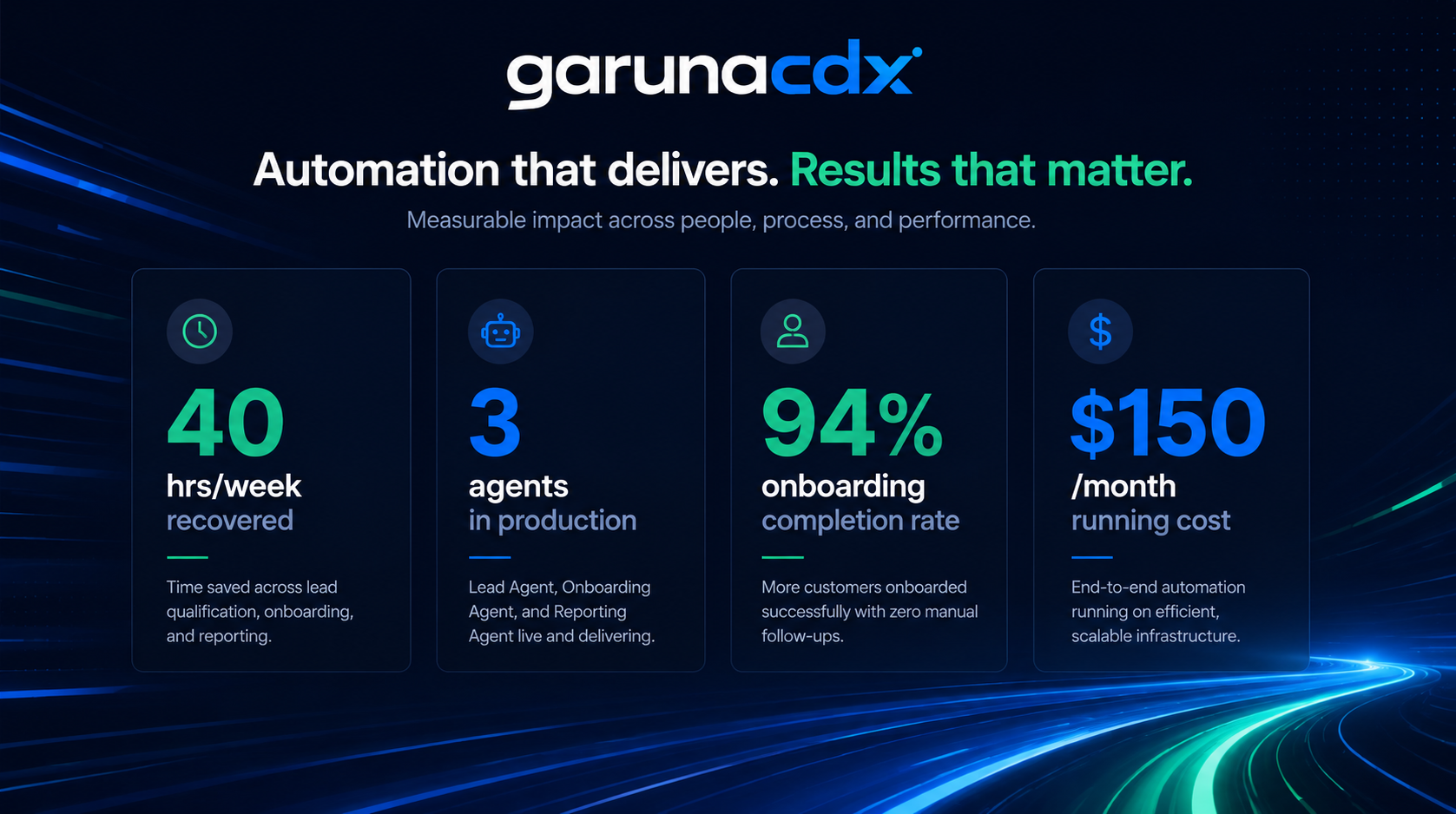
| Metric | Before | After |
|---|---|---|
| Time on lead qualification | ~20 hrs/week | ~2 hrs/week (review only) |
| Time on onboarding | ~2.5 hrs per client | ~30 mins per client |
| Time on weekly reporting | 3–4 hrs/week | 0 hrs/week |
| Onboarding completion rate | 71% | 94% |
| Time to first client touchpoint | 2–6 hours | < 5 minutes |
| Monthly infrastructure cost | — | < $150 |
Key takeaways
- 01Agent architecture beats automation scripts — reasoning handles edge cases that rules cannot
- 02The highest-ROI automation in any service business is the post-signing client touchpoint
- 03A three-agent production system can run for under $150/month while replacing 40+ hours of weekly labour
About GarunaCDX
GarunaCDX Software Solutions LLP builds AI automation systems, custom software, and web products for businesses that want technology that actually performs. We are based in Panvel, Navi Mumbai, and work with clients across India, the US, the UK, Australia, and the UAE.
Core AI stack: Claude API · LangChain · n8n · Vercel · Prisma · Supabase · Apollo.io · Brevo
Work with us: garunacdx.com
All client data in this case study is based on a real engagement. Identifying details have been changed at the client's request. Performance metrics are verified against system logs and are available for review under NDA.
Related case studies
Run a Automation and AI agents business with similar operational pain?
Tell us your bottleneck — we’ll scope yours in a free 30-minute call.
Free consultation · Reply within 24 hours · No credit card