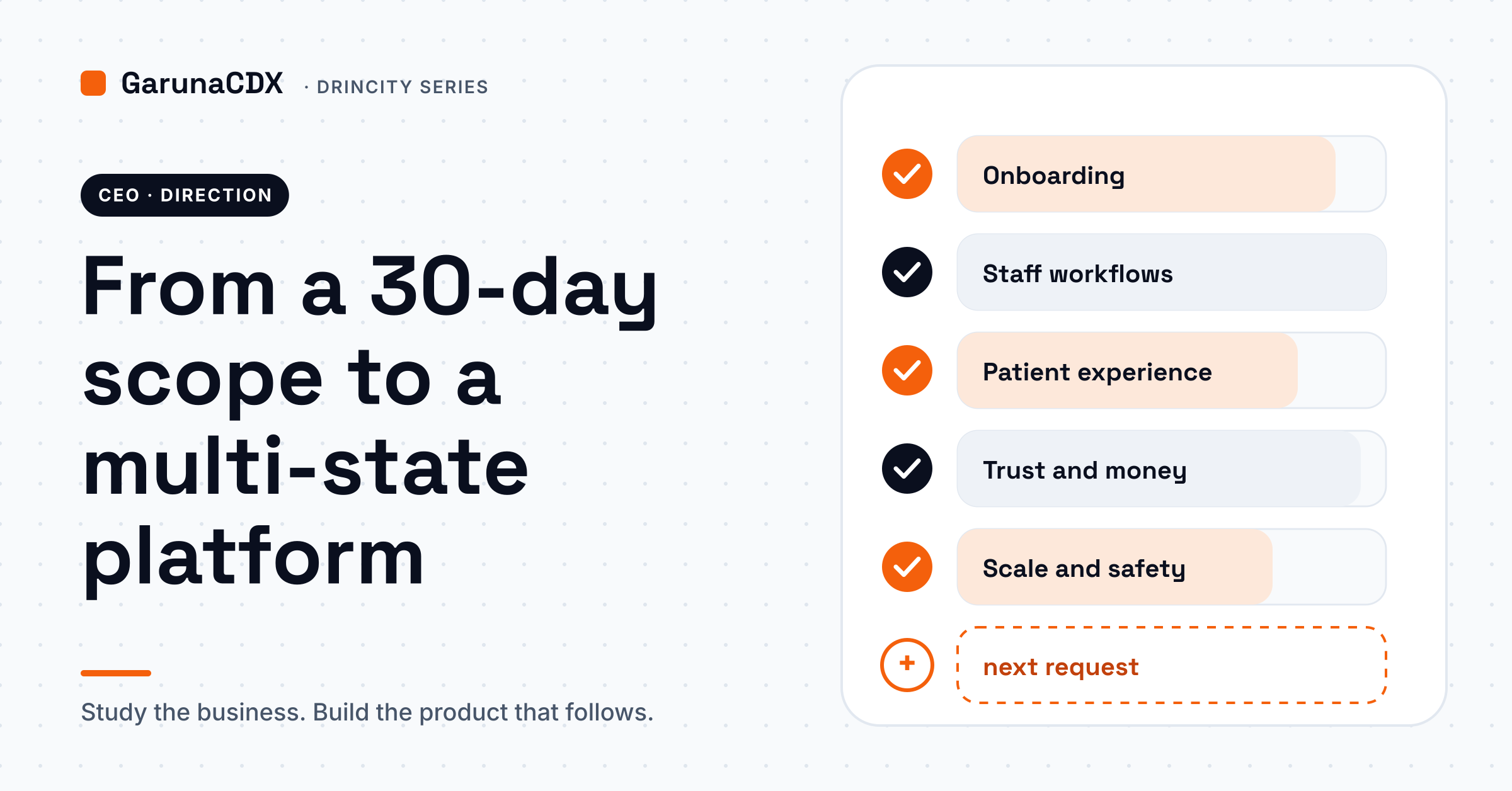
How a 30-day scope grew into a multi-state platform without losing the plot
A live product attracts requests. Three answers, all written down, kept DrInCity coherent through months of change.
- A live product attracts requests. Treat them as signals, not noise.
- Three answers: yes now, yes as a change request, reshape it. All written down.
- Reshaping is often better than building as asked: call-in became a timestamp, not a new state.
- A quiet yes is cheap today and expensive for a year.
- Ask a vendor to show you a change they reshaped instead of building as asked.
DrInCity series · The CEO’s view
Quick answer
Give every request one of three written answers: yes now (it is on the map), yes as a change request (write down what it touches and what rule it bends), or reshape it until it fits. Never a quiet yes. That is how DrInCity grew from a 30-day scope into a platform live in Mumbai and Uttar Pradesh without becoming a pile of exceptions.
The short answer
A live product attracts requests. That is a good sign, and it is where projects lose the plot. We give every request one of three answers, all written down: yes now, yes as a change request, or reshape it. There is no fourth answer called “sure, quietly”.
Why scope grows after launch
Once real people use a product, they find things to ask for. Clinic staff want a faster way in. Doctors want self-service. Operations wants to stop doing things by hand. These are signals about the business, and they are the best input a builder will ever get.
They are also how a clean product becomes a pile of exceptions. The defence is not saying no. The defence is a map and a rule.
The three answers
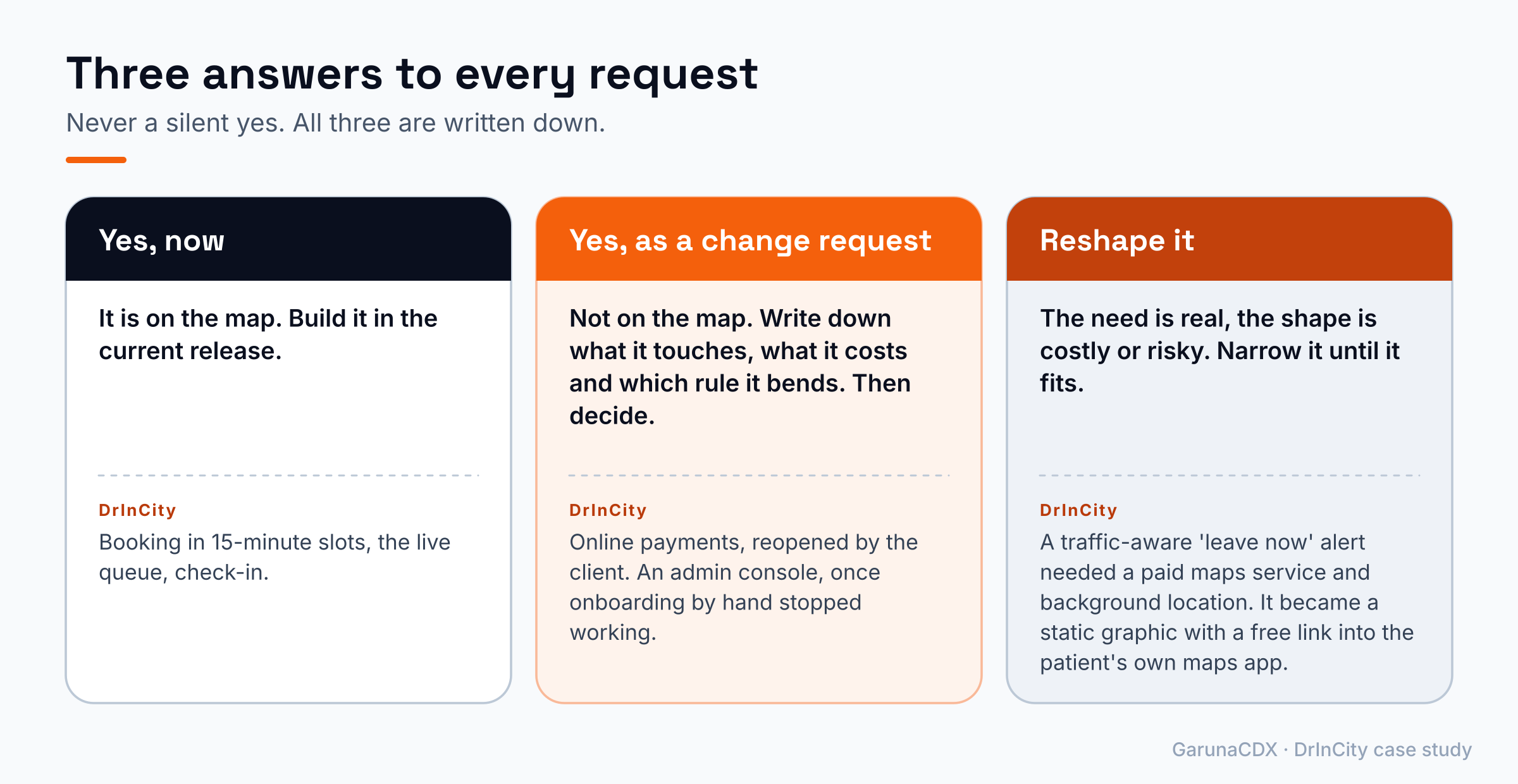
Yes, now. It is on the map. Build it in the current release.
Yes, as a change request. It is off the map. Write down what it touches, what it costs and which rule it bends. Then decide, with the client, in writing. Online payments went this way: out of the first release, reopened by the client, then built.
Reshape it. The need is real, the shape is costly or risky. Narrow it until it fits. Two examples from DrInCity:
- A traffic-aware “time to leave” alert needed a paid maps service and background location tracking. It became a simple graphic with a free link into the patient’s own maps app.
- Doctors wanted to call the next patient in. Letting them change the queue would have broken the rule that reception owns the order. So “call in” became a timestamp on the row, not a new state. The doctor gets the power, reception keeps the rule.
What DrInCity asked for
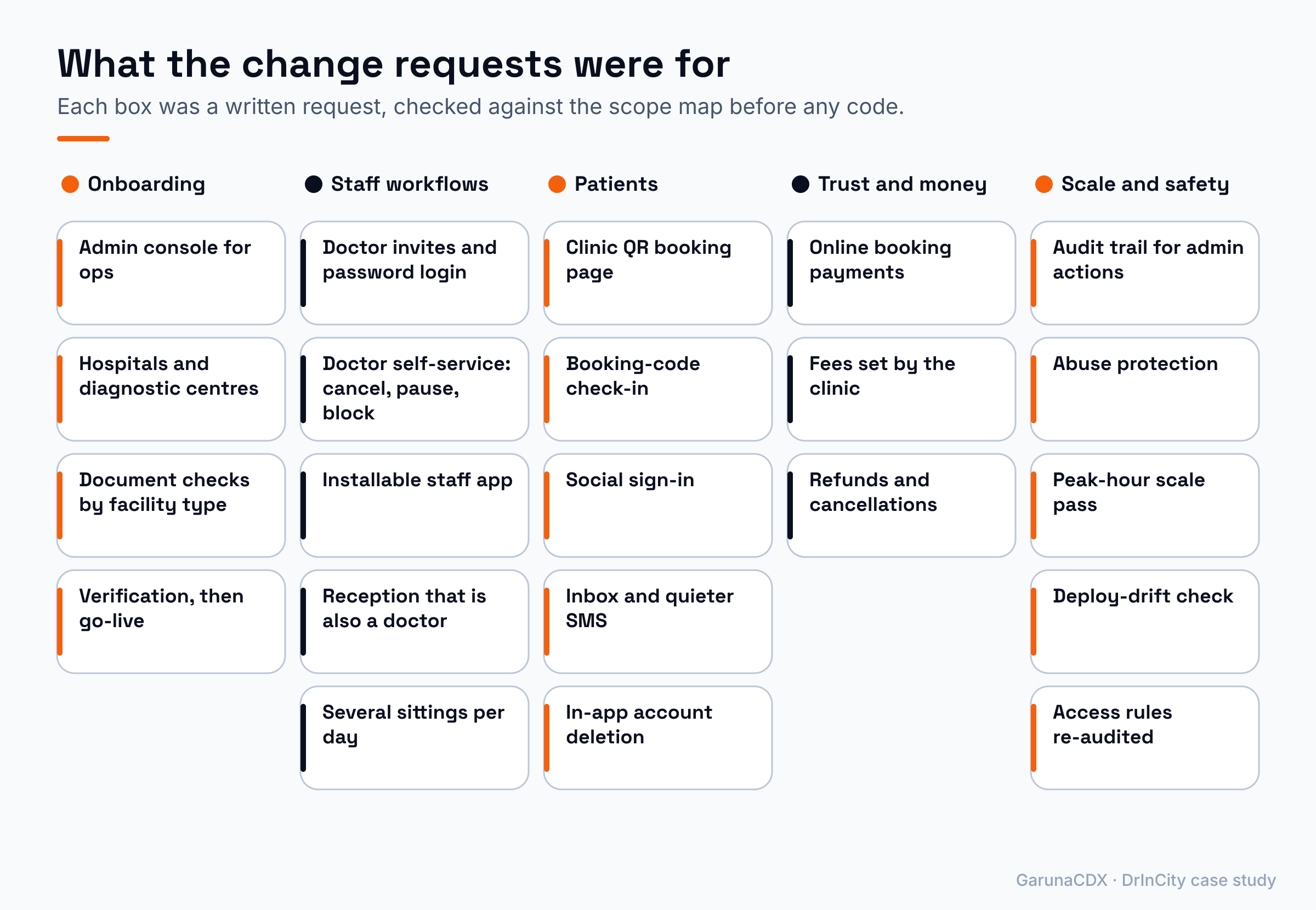
Grouped by what they were for:
- Onboarding. An admin console for our operations team, once onboarding clinics by hand stopped being realistic. Hospitals and diagnostic centres through the same funnel as clinics, with document checks by facility type.
- Staff workflows. Doctor invites and password login. Self-service for doctors to cancel, pause or block time. An installable staff app. A reception login that is also a doctor, for small clinics. Several sittings in one day, built and held back until the patient app catches up.
- Patients. A clinic booking page behind a QR poster. Check-in by booking code. Social sign-in. An in-app inbox and quieter SMS.
- Trust and money. Online booking payments, behind switches the client controls.
- Scale and safety. An audit trail for admin actions. Abuse protection. A pass for peak hours. A check that what is deployed matches the repository.
We cover the last two in the engineer’s pieces: two taps, one queue and break it before a clinic does.
What a quiet yes costs
Quiet yeses are cheap on the day and expensive for a year. Each one adds a rule nobody wrote down. Six months later nobody can say why check-in works one way for walk-ins and another for booked patients, and the next change breaks both.
A written change request costs an hour. It buys a product you can still reason about.
How to run this with a vendor
Ask three questions before you sign:
- Where is the scope map, and what is on the out-of-scope list?
- What happens when I ask for something not on it? Who decides, and where is it recorded?
- Can you show me a change you reshaped instead of building as asked?
If the answers are vague, the scope will drift, and you will find out on the invoice.
The change requests are recorded in the project’s feature map and decision log. Aadarsh confirmed the live status. We state no usage figures. Several sittings in a day exist in the backend and dashboards and are held back until the patient app supports them; we make no claim about payments beyond the fact that they were requested and built.
More by GarunaCDX
Let's talk about your build.
Tell us what you are building. A founding engineer replies within one working day with how we would approach it.